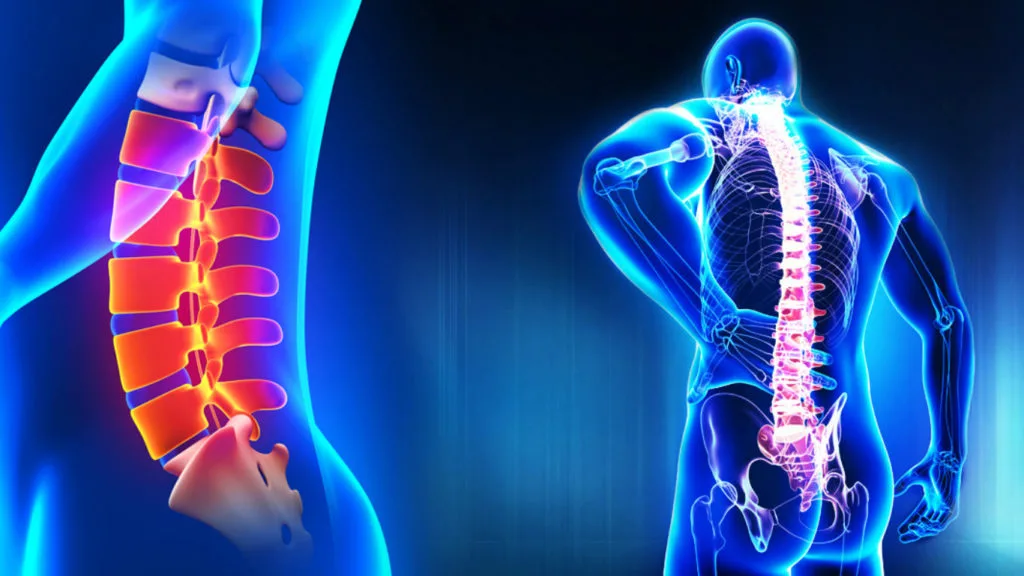
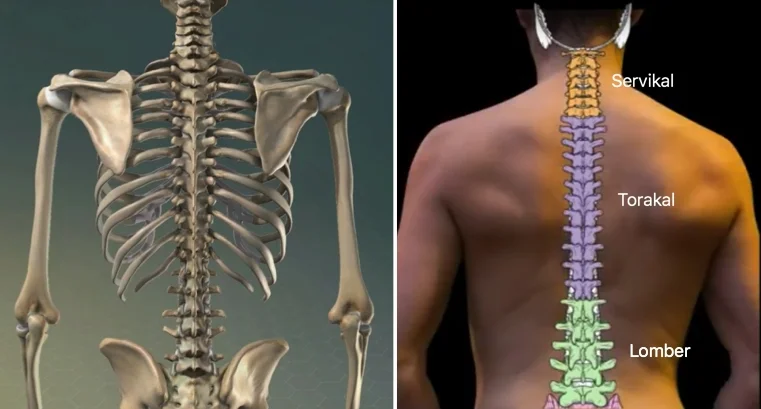
The spine is a complex structural system extending from the base of the skull to the pelvis. It supports the body, maintains balance, allows movement, and protects the spinal cord and nerve roots.
The spine is divided into:
- the cervical spine in the neck,
- the thoracic spine in the upper and middle back,
- the lumbar spine in the lower back,
- the sacrum,
- and the coccyx.
There are 7 cervical, 12 thoracic, and 5 lumbar mobile vertebrae. The sacral and coccygeal vertebrae are largely fused in adults.
The spinal system also includes:
- intervertebral discs,
- facet joints,
- ligaments,
- muscles,
- the spinal cord,
- nerve roots,
- and blood vessels.
The spine is therefore much more than a column of bones; it is an integrated system that provides support, movement, load transmission, balance, and neurological protection.
What Are the Main Functions of the Spine?
The spine helps to:
- support the head and trunk,
- maintain upright posture,
- protect the spinal cord and nerve roots,
- allow movement of the neck and trunk,
- distribute mechanical loads,
- and maintain balance.
Intervertebral discs contribute to both motion and load distribution between adjacent vertebrae.
However, the discs are not merely “shock-absorbing cushions”; they are important components of the biomechanical integrity of the spinal motion segment.
What Conditions Affect the Spine?
Common groups of spinal disorders include:
- traumatic injuries,
- disc disorders,
- degenerative spinal disease,
- spinal stenosis,
- spondylolysis and spondylolisthesis,
- scoliosis and kyphotic deformities,
- osteoporotic fractures,
- spinal infections,
- tumors,
- inflammatory disorders,
- and congenital or developmental conditions.
Importantly, not every spinal condition requires surgery.
Is All Back or Neck Pain Caused by a Serious Spinal Problem?
No.
Most episodes of neck or lower back pain are not caused by a dangerous structural disorder.
Muscle strain, physical overload, prolonged positioning, and age-related degenerative changes are common causes.
However, pain may occasionally be associated with:
- infection,
- fracture,
- tumor,
- or significant neurological compression.
For this reason, imaging findings should always be interpreted in conjunction with symptoms and physical examination.
Spinal Fractures
Spinal fractures can develop for different reasons.
Traumatic Fractures
High-energy trauma, such as motor vehicle accidents or falls from height, may cause spinal fractures.
Treatment depends on:
- fracture location,
- fracture pattern,
- spinal stability,
- and whether the spinal cord or nerve roots are affected.
Stable fractures are often managed without surgery, whereas unstable injuries or fractures causing neurological compression may require surgical treatment.
Osteoporotic Spine Fractures
In older adults and patients with osteoporosis, vertebral compression fractures may occur after relatively minor trauma.
In severe osteoporosis, fractures may occasionally occur during normal daily activities.
Treatment may include:
- pain control,
- osteoporosis management,
- rehabilitation,
- and selected interventional or surgical procedures.
Not every osteoporotic vertebral compression fracture needs surgery.
Lumbar and Cervical Herniated Disc
A herniated disc occurs when disc material protrudes or extrudes into the spinal canal, irritating or compressing a nerve.
In the lumbar spine, symptoms may include:
- lower back pain,
- pain radiating into the buttock or leg,
- numbness,
- tingling,
- weakness.
This radiating leg pain is commonly known as sciatica.
A cervical disc herniation may cause:
- neck pain,
- shoulder or arm pain,
- numbness or tingling in the hand,
- weakness.
Does Every Herniated Disc Require Surgery?
No.
Many disc herniations can be successfully managed with:
- activity modification,
- appropriate pain management,
- exercise,
- physical therapy,
- and selected spinal injections.
Surgery is more commonly considered when there is:
- progressive muscle weakness,
- significant neurological deficit,
- severe nerve compression,
- or persistent disabling pain despite appropriate nonsurgical treatment.
New bladder or bowel dysfunction, saddle numbness, or rapidly progressive bilateral neurological symptoms may indicate cauda equina syndrome and require urgent assessment.
Degenerative Spinal Disease
Age-related spinal degeneration may involve:
- loss of disc hydration and height,
- facet joint osteoarthritis,
- bone spur formation,
- thickening of spinal ligaments,
- narrowing of the spinal canal or neural foramina.
The everyday term “spinal arthritis” may therefore refer to several degenerative conditions.
Spinal Stenosis
Spinal stenosis is narrowing of the space available for the spinal cord or nerve roots.
Lumbar spinal stenosis may cause:
- leg pain with walking,
- numbness,
- heaviness,
- reduced walking distance,
- improvement when sitting or bending forward.
Degenerative disc collapse, facet arthritis, bone spurs, and ligament thickening can all contribute to narrowing of the spinal canal.
Treatment may be nonsurgical or surgical depending on the severity of symptoms.
Advanced neurological compression may require decompression surgery.
Spondylolysis
Spondylolysis is a stress fracture or defect of the pars interarticularis, a small part of the posterior vertebral arch.
It is particularly important for children and adolescents participating in sports that involve repetitive lumbar extension.
Symptoms often include lower back pain aggravated by extension.
Treatment usually includes:
- activity modification,
- temporary restriction from provocative sports,
- rehabilitation.
Spondylolisthesis
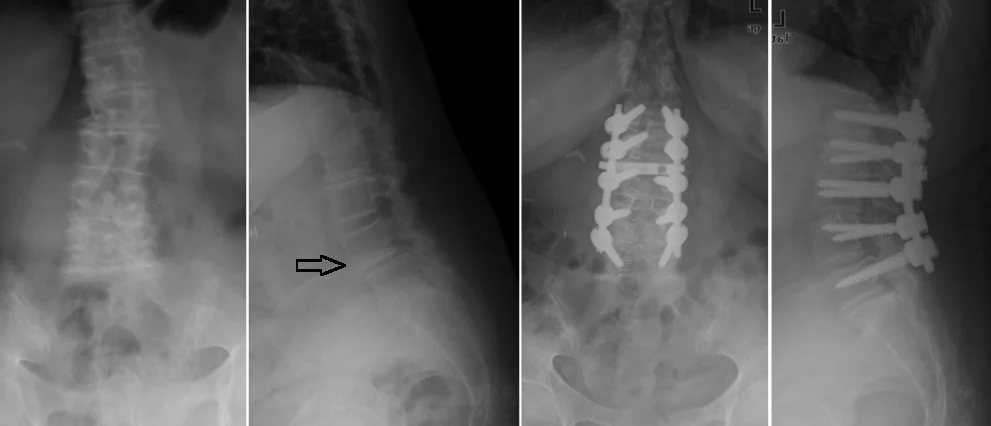
Spondylolisthesis occurs when one vertebra slips forward relative to the vertebra below.
It may be associated with spondylolysis or may develop as part of age-related degeneration.
Mild slips may cause few or no symptoms.
More advanced cases can result in:
- lower back pain,
- leg pain,
- nerve compression,
- walking difficulty.
Treatment depends on the degree and progression of the slip, neurological findings, and functional impairment.
Scoliosis
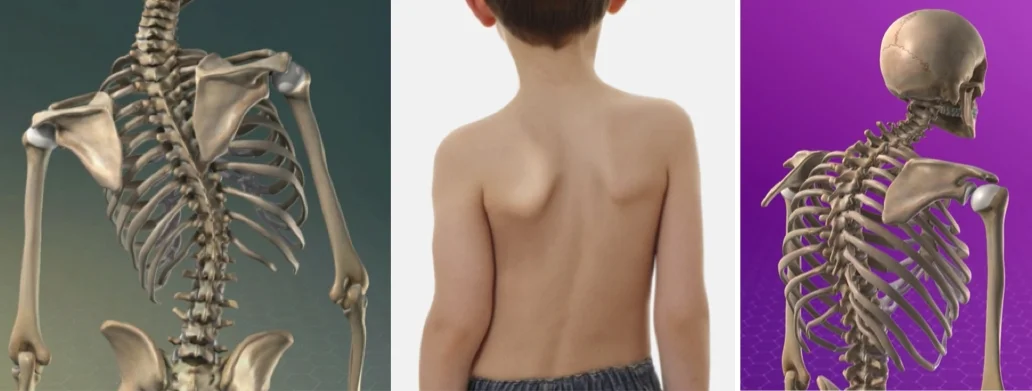
Scoliosis is not simply a sideways curvature of the spine.
It is a three-dimensional spinal deformity involving:
- lateral curvature,
- vertebral rotation,
- and trunk or rib-cage asymmetry.
Scoliosis may be:
- idiopathic,
- congenital,
- neuromuscular,
- syndromic,
- or degenerative.
The most common type in children and adolescents is adolescent idiopathic scoliosis.
Does Every Scoliosis Require Surgical Treatment?
No.
Treatment depends on:
- curve magnitude,
- age,
- remaining growth,
- progression risk,
- and clinical findings.
Management may involve:
- observation,
- exercise,
- bracing in selected growing patients,
- or surgery for significant progressive deformity.
Kyphosis
A certain degree of thoracic kyphosis is normal.
Therefore, kyphosis itself is not automatically a disease.
The problem arises when the curvature becomes excessive or structurally abnormal.
Hyperkyphosis may be related to:
- posture,
- Scheuermann disease,
- congenital disorders,
- osteoporotic fractures,
- infection,
- or tumor.
Treatment depends on the cause and severity.
Cervical Myelopathy
Compression of the spinal cord in the neck can cause cervical myelopathy.
Symptoms may include:
- loss of hand dexterity,
- difficulty buttoning clothes or writing,
- dropping objects,
- balance problems,
- leg stiffness or weakness.
Cervical myelopathy should not be considered simply a form of neck pain.
Progressive spinal cord compression may require surgical treatment.
Spinal Infections
Spinal infections can involve:
- the vertebrae,
- intervertebral discs,
- or epidural space.
Conditions include:
- vertebral osteomyelitis,
- spondylodiscitis,
- and epidural abscess.
Tuberculosis and brucellosis are important specific causes, in addition to common bacterial infections.
Symptoms may include:
- persistent back pain,
- fever,
- night pain,
- systemic illness.
Treatment is primarily based on appropriate antimicrobial therapy.
Surgery may be necessary when there is:
- abscess formation,
- neurological compression,
- spinal instability,
- significant deformity,
or failure of medical treatment.
Spinal Tumors
Both benign and malignant tumors can affect the spine.
Tumors may originate within spinal structures or represent metastatic spread from another organ.
Metastatic spinal disease is much more common than primary malignant spinal tumors.
Cancers that frequently metastasize to the spine include:
- breast,
- prostate,
- lung,
- and kidney cancer.
Symptoms may include:
- persistent back pain,
- fever,
- night pain,
- systemic illness.
Surgery may be combined with radiotherapy, systemic oncology treatment, or other therapies.
What Types of Spine Surgery Are Performed?
Depending on the condition, procedures may include:
- discectomy,
- microdiscectomy,
- laminectomy,
- laminotomy,
- nerve-root decompression,
- spinal fusion,
- instrumentation with pedicle screws,
- deformity correction,
- tumor surgery,
- infection debridement,
- and artificial disc replacement in selected patients.
What Is Decompression Surgery?
Decompression means surgically relieving pressure on the spinal cord or nerve roots.
It may be performed for:
- instability,
- extent of disease,
- overall medical condition.
The goal is to:
- protect neural tissue,
- reduce pain,
- and preserve or improve neurological function.
What Is Spinal Fusion?
Spinal fusion is a procedure in which two or more vertebrae are encouraged to heal into a single, stable unit.
It may be used for:
- instability,
- selected spondylolisthesis,
- spinal deformity,
- traumatic injury,
- and certain degenerative conditions.
The exact surgical technique and implants depend on the individual pathology.
Minimally Invasive Spine Surgery
Some spinal procedures can be performed through smaller incisions using specialized techniques.
Potential advantages may include:
- less muscle disruption,
- reduced blood loss,
- faster early recovery in selected patients.
However, not every spinal disorder is suitable for minimally invasive surgery.
The technique should be selected based on the pathology rather than solely on the size of the incision.
When Is Spine Surgery Necessary?
Spine surgery should not be recommended solely because an abnormality is visible on an MRI.
It may be considered in the presence of:
- progressive neurological deficit,
- spinal cord compression,
- severe nerve-root compression,
- instability,
- progressive deformity,
- significant functional impairment despite appropriate nonsurgical treatment,
- selected fractures,
- infection,
- or tumors.
The purpose of surgery is to provide meaningful clinical benefit rather than simply improve imaging appearance.
Which Symptoms Require Urgent Assessment?
Urgent medical assessment is particularly important with:
- new or rapidly progressive arm or leg weakness,
- new bladder or bowel dysfunction,
- numbness in the saddle or perineal region,
- severe spinal pain after significant trauma,
- severe back pain with fever,
- new severe spinal pain in a patient with known cancer,
- unexplained persistent night pain,
- rapidly worsening balance or walking ability.
The Main Principle of Spine Treatment
In spinal disorders, the goal is not merely to treat the structural changes seen on an MRI.
The correct approach should be based on
the patient’s symptoms + neurological examination + functional status + imaging findings,
all of which must be evaluated together.
Surgery should be considered only if it is expected to provide the patient with a meaningful clinical benefit.
The primary goal:
to protect nerve tissue, reduce pain, ensure spinal balance and stability, and restore the patient’s activities of daily living as much as possible!!! disorders should not be treated according to MRI findings alone !!!