Pediatric orthopedics is a specialized field of orthopedic surgery dealing with congenital, developmental, neuromuscular, and traumatic conditions of the musculoskeletal system from infancy through childhood and adolescence.
The word “orthopedics” originates from Ancient Greek. Orthos means “straight” or “correct,” while paidos refers to a child. The term was originally introduced in the 18th century to describe the prevention and correction of deformities in children.
Although modern orthopedics now covers musculoskeletal disorders in patients of all ages, the care of growing children remains an important and highly specialized part of the field.
Some orthopedic conditions that begin during childhood can continue to affect the patient throughout adult life. Early recognition, appropriate observation, and timely treatment can therefore have a major impact on long-term musculoskeletal health.
What Age Group Does Pediatric Orthopedics Cover?
Pediatric orthopedics generally covers the period from birth until skeletal growth is complete.
This includes:
- newborns,
- infants,
- children,
- and adolescents.
Some congenital, developmental, or neuromuscular conditions that begin during childhood may continue into adulthood, and their long-term consequences may also be evaluated by orthopedic surgeons experienced in pediatric conditions.
Why Are Children Not Simply Small Adults?
A child’s musculoskeletal system is continuously growing and changing.
The growth plates, located near the ends of many bones, allow the skeleton to grow in length. Bone structure, joint anatomy, ligament flexibility, and muscle function also change considerably throughout childhood.
For this reason, the same orthopedic condition may behave very differently in a child and an adult.
Children’s bones, for example, have a greater capacity for remodeling. Therefore, certain fractures that might require surgery in an adult can often be treated successfully without surgery in a young child.
However, growth also creates unique risks.
Damage to a growth plate may interfere with future bone growth and can sometimes result in:
- angular deformity,
- limb-length discrepancy,
- or changes in the shape of a nearby joint.
Pediatric orthopedic treatment therefore requires consideration not only of the child’s current condition but also of how that condition may interact with future growth.
Why Is Early Diagnosis Important In Pediatric Orthopedics?
For some pediatric orthopedic conditions, the success and complexity of treatment can depend greatly on the age at which the problem is recognized.
Conditions such as:
- developmental dysplasia of the hip,
- clubfoot,
- certain limb deformities,
- and growth-plate disorders
may often be treated with simpler and less invasive methods when identified early.
Delayed diagnosis may sometimes result in the need for more complex treatment or surgery.
Which Symptoms Should Prompt An Orthopedic Evaluation?
Parents should consider orthopedic assessment if a child has:
- persistent limping,
- unexplained hip, knee, or limb pain,
- bone pain that wakes the child at night,
- a clear difference between the two arms or legs,
- progressive bowing or angulation of the legs,
- visible spinal asymmetry,
- recurrent joint dislocations,
- persistent toe walking,
- inability to use a limb after an injury,
- joint swelling or loss of motion,
- or an obvious congenital abnormality of an arm, leg, hand, or foot.
Symptoms associated with pain, loss of function, or progressive asymmetry deserve particular attention.
Does Every Childhood Deformity Require Treatment?
No.
The appearance and alignment of children’s legs and feet change naturally as they grow.
At certain ages, features such as:
- mild bowlegs,
- knock-knees,
- intoeing,
- and flexible flat feet
may be normal developmental variations.
One of the most important roles of pediatric orthopedics is therefore to distinguish normal development from true disease.
Avoiding unnecessary treatment is just as important as recognizing conditions that require timely intervention.
Treatment Options In Pediatric Orthopedics
Whenever possible, pediatric orthopedic treatment is designed to take advantage of the child’s natural growth and healing potential.
Treatment options may include:
- observation,
- physical therapy and exercise,
- casting,
- orthoses and braces,
- serial casting,
- closed reduction,
- minimally invasive surgery,
- guided-growth procedures,
- muscle and tendon surgery,
- corrective osteotomy,
- fracture fixation,
- and more complex reconstructive surgery when required.
The goal is not simply to correct the deformity that is present today.
The main objective is to help the child continue to grow as normally as possible, maintain mobility and function, and reach adulthood with the best possible musculoskeletal function.
Common Conditions Treated in Pediatric Orthopedics
Pediatric orthopedics covers a broad range of musculoskeletal conditions.
The main groups of diseases and conditions are summarized below.
Developmental Dysplasia of the Hip
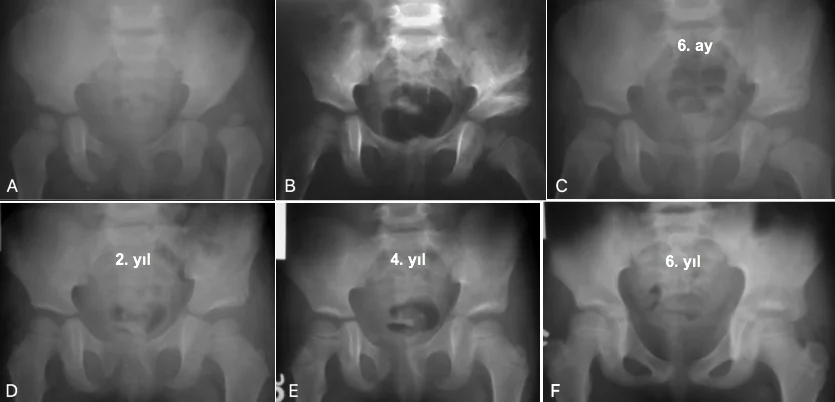
Developmental dysplasia of the hip (DDH) refers to a spectrum of conditions in which the relationship between the femoral head and the acetabulum does not develop normally.
The older term “congenital hip dislocation” is now used less frequently because DDH includes much more than complete dislocation and may sometimes develop during infancy rather than being fully present at birth.
DDH can range from:
- mild underdevelopment of the acetabulum,
- to hip instability,
- subluxation,
- or complete dislocation.
When diagnosed early in infancy, many cases can be treated without surgery. More advanced cases or those diagnosed later may require surgical treatment.
Clubfoot
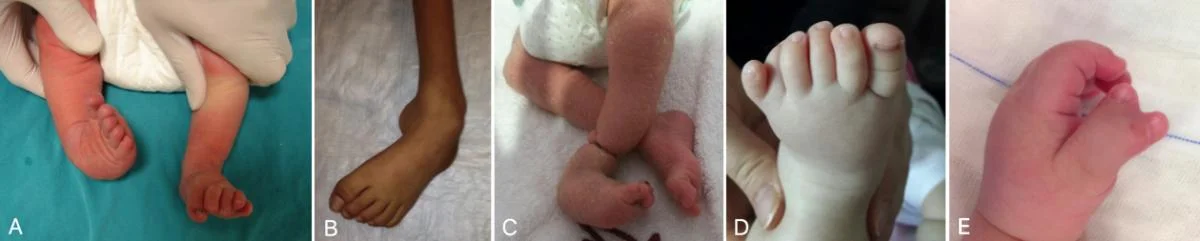
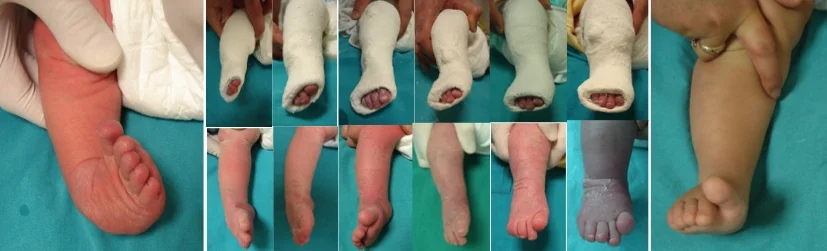
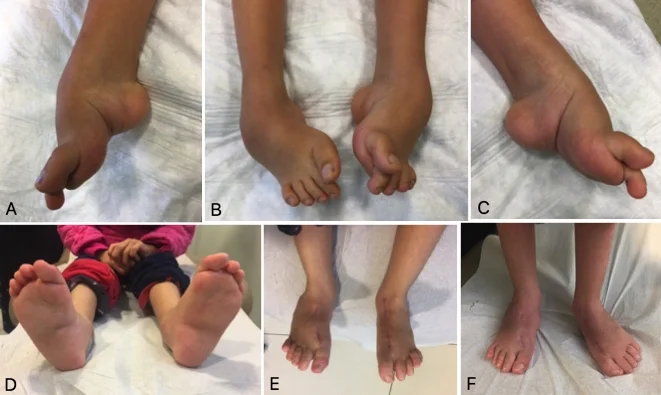
Clubfoot, also known as congenital talipes equinovarus, is a congenital deformity in which the foot is turned inward and downward.
The Ponseti method is now the standard approach for many infants.
Treatment commonly involves:
- a series of corrective casts,
- a minor Achilles tenotomy when required,
- followed by the use of a special brace.
It is crucial for the success of the treatment that corrective cast treatment is started within the first week after birth. As with many pediatric orthopaedic conditions, corrective surgery is carried out at a later stage to address this problem.
Orthopedic Problems Associated With Cerebral Palsy
Cerebral palsy is a group of permanent disorders of movement and posture caused by a non-progressive injury or disturbance affecting the developing brain.
Although the term “congenital brain palsy” is used in everyday language, it does not fully describe cerebral palsy; the condition may arise before birth, during birth or in early childhood.
Children with cerebral palsy may develop:
- increased muscle tone,
- muscle contractures,
- foot deformities,
- hip instability or dislocation,
- limitations of hip and knee motion,
- gait abnormalities,
- and scoliosis.
Treatment aims not simply to correct deformity but to improve the child’s ability to sit, stand, walk, and participate in daily activities.
Management may include:
- physical therapy,
- orthoses,
- botulinum toxin injections,
- selected muscle or tendon procedures,
- corrective bone surgery,
- and other reconstructive procedures when necessary.
Spina Bifida and Myelomeningocele
Congenital neurological conditions such as spina bifida and myelomeningocele can affect muscle function and musculoskeletal development.
Children may develop:
- hip disorders,
- knee deformities,
- foot deformities,
- scoliosis,
- and difficulties with walking.
Care frequently requires a multidisciplinary team including orthopedic surgery, neurosurgery, pediatric neurology, rehabilitation, and urology.
Perthes Disease
Legg-Calvé-Perthes disease is a childhood hip disorder caused by a temporary interruption of the blood supply to the femoral head.
Children may present with:
- hip or groin pain,
- a limp,
- pain referred to the knee,
- and reduced hip movement.
The course of the disease varies according to the child’s age, the extent of femoral head involvement, and hip mobility.
Treatment aims to preserve the round shape of the femoral head and maintain the best possible relationship between the femoral head and acetabulum.
Slipped Capital Femoral Epiphysis
Slipped capital femoral epiphysis (SCFE) is an important hip disorder that most commonly develops during adolescence.
Patients may complain of pain in the:
- hip,
- groin,
- thigh,
- or even only the knee.
A limp is common.
Early recognition is important. Once SCFE is diagnosed, surgical stabilization is generally required to prevent further slipping.
For this reason, in overweight adolescents presenting with knee pain of unknown cause, the hip should also be assessed as a possible source of the symptoms.
Pediatric Fractures
Children’s bones differ significantly from adult bones.
Because their bones are more flexible and their periosteum is relatively strong, children may develop characteristic fracture patterns such as:
- greenstick fractures,
- buckle or torus fractures,
- and plastic deformation.
Growth plates are another important feature of the pediatric skeleton.
Many childhood fractures can be treated successfully with a cast or splint. Surgery may be required for certain fractures that are:
- significantly displaced,
- involving a joint surface,
- involving the growth plate,
- open,
- or associated with nerve or vascular injury.
Treatment is individualized according to the child’s age, remaining growth potential, fracture location, and fracture pattern.
Gait Abnormalities
Concerns about the way a child walks are among the most common reasons for pediatric orthopedic consultation.
These may include:
- intoeing,
- out-toeing,
- toe walking,
- limping,
- bowlegs,
- or knock-knees.
Many variations in childhood gait are part of normal growth and improve naturally without treatment.
However, persistent pain, marked asymmetry, progression, unilateral abnormalities, or developmental delay may require further evaluation.
Pediatric Foot Problems
Common pediatric foot conditions include:
- flexible or rigid flatfoot,
- intoeing,
- toe walking,
- clubfoot,
- cavus foot,
- accessory navicular,
- tarsal coalition,
- and congenital toe abnormalities.
Not every child with flat feet requires special shoes, insoles, or surgery. Flexible flatfoot is particularly common in children and is often a normal developmental variation.
Limb-Length Discrepancy and Angular Deformities
Differences in the length of the legs can be congenital or develop later during childhood.
Possible causes include growth-plate injuries, infections, congenital conditions, and certain neurological disorders.
Children may also develop angular or rotational conditions such as:
- genu varum,
- genu valgum,
- and rotational abnormalities.
Some of these are normal stages of growth, while progressive or severe deformities may require treatment.
Because children continue to grow, selected deformities can sometimes be corrected through relatively small procedures known as guided growth, which use the remaining growth potential to gradually improve alignment.
Spinal Deformities
Children and adolescents may develop spinal conditions including:
- scoliosis,
- kyphosis,
- spondylolysis,
- and spondylolisthesis.
In growing children with scoliosis, the risk of progression is closely related to the amount of skeletal growth remaining.
Treatment may include:
- observation,
- exercise,
- bracing,
- or surgery,
depending on the type and magnitude of the deformity and the child’s remaining growth.
Brachial Plexus Birth Injuries
The brachial plexus is a network of nerves that controls much of the movement and sensation of the arm. Injury to these nerves around the time of birth may cause varying degrees of weakness or loss of movement.
Many children improve considerably with time, while some may develop persistent muscle imbalance and joint deformity.
Treatment may range from physical therapy to nerve surgery, tendon transfers, or corrective bone procedures.
Congenital Limb and Digit Differences
Pediatric orthopedic surgeons also evaluate congenital conditions such as:
- extra fingers or toes (polydactyly),
- fused fingers or toes (syndactyly),
- congenital limb deficiencies,
- constriction band syndrome,
- and congenital bone deformities.
Treatment is individualized according to the functional effect and characteristics of the deformity.
Sports Injuries in Children and Adolescents
As participation in organized and recreational sports has increased, sports-related injuries have become increasingly important in children and adolescents.
These may include:
- ligament injuries,
- meniscal injuries,
- osteochondral lesions,
- apophyseal injuries,
- stress fractures,
- and muscle or tendon problems.
Because many children still have open growth plates, surgical techniques designed for adults cannot always be applied in exactly the same way.
Bone and Soft-Tissue Tumors in Children
Both benign and malignant tumors can occur in the pediatric musculoskeletal system.
Most bone lesions in children are benign. However, symptoms such as persistent or increasing bone pain, pain at night, unexplained swelling, or a palpable mass require appropriate assessment.
X-rays, MRI, and other investigations may be required depending on the findings.
The Fundamental Principle of Pediatric Orthopedics
One of the most important principles of pediatric orthopedic care is performing the right intervention at the right time.
Some conditions require only observation, while early treatment of others may prevent significant deformity or disability later in life.
The philosophy of pediatric orthopedics can therefore be summarized simply:
A child should be evaluated not only for the orthopedic problem present today, but also in terms of future growth and long-term function !!!